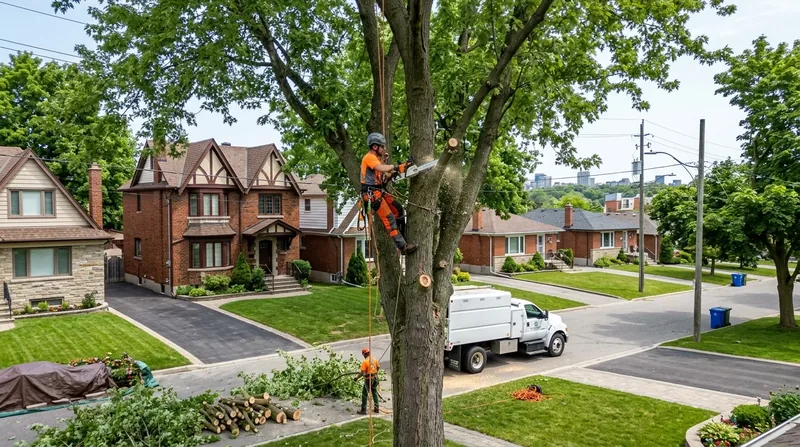




Tree trimming in Toronto keeps your mature maples, oaks and birches healthy, well-shaped and clear of your roof, siding and walkways. Toronto's post-war subdivisions are full of trees planted 50 to 70 years ago; many now overhang homes, drop heavy branches during ice storms, or crowd neighbouring properties. Professional trimming removes dead wood, improves structure and reduces storm risk without removing the tree. We are ISA Certified Arborists working across the Toronto area since 2015, fully insured and equipped to work safely in tight backyards, on ravine lots and near utility lines. A free estimate takes 15 minutes and costs nothing.
Why tree trimming matters in Toronto
Mature trees are assets, but they need regular maintenance. In Toronto, heavy snow and ice load branches to the breaking point; summer windstorms snap weak or diseased limbs. Overgrown trees also block sunlight from your home, trap moisture in gutters and create a falling-branch hazard over driveways and patios. Structural pruning removes crossing branches, improves air flow through the canopy and redirects growth away from your house. Unlike tree removal, trimming preserves the tree for another 20 to 40 years.
- We remove dead, diseased and crossing branches to prevent storm failure.
- We thin the canopy to allow light and air circulation through dense growth.
- We raise the crown to clear roof lines, gutters and second-storey siding.
- We reduce overall height or weight on trees that overhang neighbours' properties.
- We clean up all debris on site and chip branches for mulch or removal.
Trimming every 3 to 5 years keeps trees strong and prevents costly emergency removals later.
Toronto reality: A mature 15-metre silver maple overhanging a roof typically costs $400 to $650 to trim properly. The same tree left untended may drop a 2-tonne limb during an ice storm, causing $5,000 to $15,000 in roof and gutter damage. Regular trimming costs far less than emergency repair.
How we trim your trees
We start with a walk-around to assess the tree's health, structure and hazards. We identify dead wood, crossing branches and growth patterns, then explain what we will remove and why. Our crew uses rope and harness work for branches over 5 metres; smaller trees are trimmed from ladders or the ground. All cutting follows ISA standards to avoid flush cuts, branch stubs and bark damage that invite disease. We lower large limbs by rope to protect your property and neighbour's fence.
- We inspect the tree for disease, pest damage (including emerald ash borer signs) and structural weakness.
- We remove all dead wood back to live branch collar, never leaving stubs.
- We thin crossing and rubbing branches to improve internal air flow.
- We make heading cuts only when necessary to redirect growth safely away from structures.
- We lower limbs under control and chip all branches on site.
- We haul away logs, brush and cleanup debris unless you ask us to leave chips for mulch.
Most residential trees in Toronto take 2 to 4 hours. We work Monday to Saturday, 7 a.m. to 5 p.m., and respect your neighbours' quiet time.
Example: A 12-metre red oak in Mimico with three large crossing branches and dead interior wood typically takes 3 hours and costs $475 to $575, including cleanup. If the tree is on a ravine lot or requires special rigging over a deck, the cost rises to $650 to $850.
Trimming methods and when to use them
| Method | What it does | When to use it |
|---|---|---|
| Crown thinning | Remove 10 to 20 per cent of live branches throughout the canopy to improve light and air flow. | Dense, overgrown trees; trees shading your home or garden; trees with interior dead wood. |
| Crown raising | Remove lower branches up to 3 to 4 metres to clear roof lines, gutters, decks and sight lines. | Trees overhanging your house or blocking views; trees touching second-storey siding or gutters. |
| Crown reduction | Reduce overall height or spread by 20 to 30 per cent, cutting back to lateral branches of appropriate size. | Trees too large for their lot; trees overhanging neighbours' property; trees in danger of storm failure. |
| Deadwood removal | Remove all dead branches, typically 2 to 5 cm or larger, back to live branch collar. | Any tree showing signs of age, disease or storm damage; reduces pest habitat and fall hazard. |
| Clearance pruning | Remove branches within 1 to 2 metres of private electrical service lines; respects utility approach distance. | Trees near your home's power line entry; essential for safety and to avoid utility company complaints. |
We never use climbing spurs on living trees, never make flush cuts and never "top" trees (cut all branches to a uniform height). Topping weakens trees, triggers dense regrowth and shortens lifespan by 10 to 20 years.
Permits and regulations in the Toronto area
The City of Toronto may require a permit before you remove a private tree, depending on size and location. If a permit is required, an arborist report supports your application and often speeds approval. We can prepare that report at no extra charge when you book a free estimate. Rules and thresholds differ from one municipality to the next across the Toronto area, Mississauga, Vaughan, Markham and beyond. We know local requirements and advise you at the start of every job.
When trees grow near your private electrical service entrance (the wire from the pole to your house), we maintain safe approach distances and never touch the public distribution network operated by your local utility or Hydro One. Branches within 1 to 2 metres of your service line are trimmed from the ground or ladder, never climbed.
All debris is chipped on site or hauled away in our truck. We do not leave brush piles on the street or in your yard unless you request mulch. Stumps are left in place unless you book stump grinding as a separate service.
Seasonal timing for tree trimming
Trimming and structural pruning are best done in dormancy, from late fall to late winter, when trees are not actively growing and you can see the branch structure clearly. Winter pruning also reduces disease spread and allows the tree to heal before spring growth. Summer trimming is acceptable for deadwood removal and emergency clearance, but avoid heavy pruning during active growth. Cedar hedge trimming is best done in late spring and summer to shape new growth and maintain density.
Emergency removals and clearance work happen year-round. We respond to storm damage, fallen branches and hazard trees 24/7. Ice storms and summer windstorms peak in late winter and mid-summer, so our crews work extended hours during those seasons.
Contact us at Toronto Tree Trimming or call (437) 600-1089 to schedule your free estimate. We will inspect your trees, explain what trimming will achieve and give you a firm quote with no hidden costs. If you need clarification on municipal rules or want to discuss tree cabling and bracing as an alternative to removal, we are here to help.
Prices Tree Trimming in Toronto — Indicative pricing
| Service | Price | Details |
|---|---|---|
| Small tree trimming (up to 10 metres) | From $275 | Deadwood removal, light thinning, clearance work |
| Medium tree trimming (10 to 15 metres) | From $400 | Crown thinning, crown raising, branch removal |
| Large tree trimming (15 to 20 metres) | From $650 | Rope work, crown reduction, complex rigging |
| Multiple trees or complex site | From $1,200 | Ravine lots, tight access, multiple species, extensive cleanup |
| Free estimate | No charge | Detailed inspection, written quote, no obligation |
Indicative prices; free, personalized estimate within 24h at (437) 600-1089.