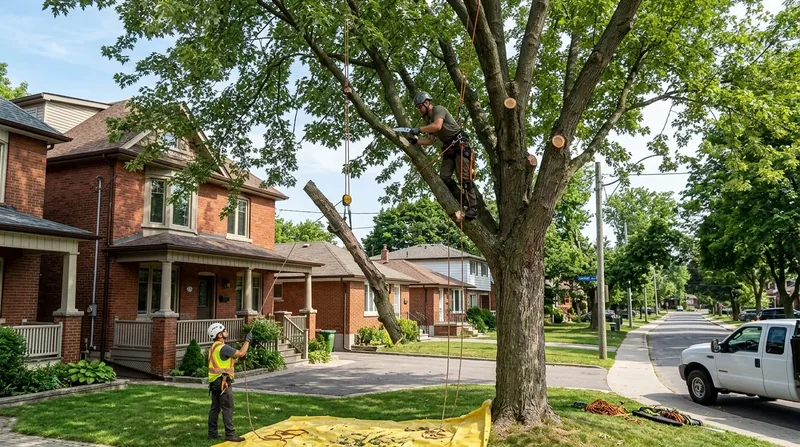




Tree pruning in Toronto keeps mature maples, oaks and spruces healthy, reduces the risk of limb failure, and opens your yard to light again. Toronto's post-war subdivisions are packed with 40- to 60-year-old street trees that need selective structural pruning every five to seven years. Our ISA Certified Arborists work to industry standards, timing each cut to the dormancy window that suits the species. Whether you have a sugar maple shading your deck in Etobicoke, a Norway spruce crowding your roof in North York, or a cluster of birch on a ravine lot, we assess the tree's structure, remove crossing and dead wood, and thin the crown without stripping it bare. Toronto Tree Trimming has been doing this work since 2015, and we handle everything from the initial site visit to cleanup and chipping.
Why structural pruning matters for Toronto trees
Toronto's climate brings ice storms, summer windstorms and freeze-thaw cycles that test tree structure every year. A tree with crossing branches, included bark, or a weak crotch angle is a liability waiting to happen. Structural pruning removes those failure points before a limb takes down a fence, crushes a car or threatens the house. It also improves air circulation through the canopy, reducing fungal disease and letting grass grow back underneath.
- Remove dead, diseased and crossing branches that create weak points.
- Thin the crown to reduce wind load and improve light penetration.
- Correct branch angles and remove included bark that weakens the attachment.
- Cut back branches overhanging structures, utilities or property lines.
- Maintain the tree's natural form and vigour throughout the process.
Each cut is made just outside the branch collar, following ISA standards, so the tree can compartmentalise the wound and heal properly. We never leave stubs or flush-cut into the trunk, and we never remove more than 25 per cent of the living canopy in a single season.
Local example: A 50-year-old red oak in Rosedale with three competing leaders and two large dead limbs over a deck typically costs $800 to $1,200 for full structural pruning, cleanup and chipping. A smaller silver maple in a Mimico backyard, 35 feet tall with light thinning, runs $450 to $650.
How we prune your trees in the GTA
We start with a walk-around assessment: we check the tree's age, species, health and structure, identify any hazards, and discuss your goals (shade retention, light restoration, clearance from the house). Then we plan the cuts, determine equipment and crew size, and schedule the work in the right dormancy window. For most deciduous species in Toronto, that is late fall through late winter. Evergreens like spruce and cedar can be pruned in late spring and summer.
- Inspect the entire crown and trunk for dead wood, disease and structural defects.
- Plan cuts to balance the tree and remove hazards without over-thinning.
- Climb and cut using certified techniques and proper rigging for large limbs.
- Lower branches safely to the ground using ropes and equipment as needed.
- Chip all brush on site and haul away larger logs, leaving your yard clean.
We work quietly and efficiently, typically finishing a medium tree in four to six hours. Large or complex jobs take a full day or two. All debris is chipped or hauled away, so you do not have piles of branches left behind.
Real scenario: A property in Long Branch with a 60-foot silver maple overhanging the garage and a 40-foot birch crowding the fence line. Both trees are structurally sound but overgrown. Pruning both, with full cleanup and chipping, takes one full day and costs between $1,400 and $1,800, depending on access and debris volume.
Pruning methods we use
| Method | Description | When we use it |
|---|---|---|
| Crown thinning | Selective removal of branches throughout the crown to improve light and air flow. | Most common method for mature Toronto trees; reduces wind load and disease risk. |
| Crown raising | Removal of lower branches to increase clearance above the ground, driveway or roof. | Essential when branches hang over structures or block sightlines on property lines. |
| Crown reduction | Shortening the overall height and spread by cutting back major branches to lateral buds. | Used when a tree is too large for its space or poses a hazard near power lines. |
| Hazard removal | Targeted removal of dead limbs, diseased wood and branches with included bark or poor angles. | Done year-round whenever a safety risk is identified; does not require dormancy. |
All methods follow ISA standards for pruning cuts and branch collar preservation. We never use climbing spikes on the trunk (they create wounds), and we never coat cuts with wound dressing, which slows compartmentalisation. The tree does the healing itself.
Timing and seasonal considerations
Dormancy pruning (late fall to late winter) is ideal for most deciduous trees in Toronto because the tree is not expending energy on new growth and wound closure is faster in spring. Cedar hedges, however, are best pruned in late spring and summer to avoid winter dieback. If you have a dead limb or a branch hanging over the house, we remove it immediately regardless of season. General tree trimming can happen year-round for safety reasons, but structural pruning is most effective in winter.
Storm damage and hazard removals are our 24/7 emergency service. Ice storms and summer windstorms often leave broken limbs or entire trees leaning against houses or power lines. We respond the same day or next morning, depending on the queue.
Municipal permits and regulatory requirements
The City of Toronto requires a permit for many private tree removals, and an arborist report typically supports that application. Pruning alone usually does not trigger a permit, but if the tree is on a protected list or the work is extensive, the City may ask for documentation. Rules differ across the GTA: Mississauga, Brampton, Vaughan and Markham each have their own thresholds and processes. We know the local bylaws and can advise you on whether your tree needs a report before work begins.
If your pruning involves branches near hydro lines, we maintain safe approach distances from the private service entrance to your house. We do not work on the public distribution network of Toronto Hydro or Hydro One, and we respect all clearance rules. Utility line clearance is a specialised service, and we handle it carefully.
All our work is fully insured. We carry liability coverage and provide a certificate of insurance on request. Cleanup and debris removal are included in every quote.
Prices Tree Pruning in Toronto — Indicative pricing
| Service | Price | Details |
|---|---|---|
| Small tree pruning (25–35 feet) | From $350 | Crown thinning, hazard removal and cleanup for birch, smaller maple or spruce |
| Medium tree pruning (35–50 feet) | From $650 | Structural pruning, branch removal and full site cleanup for mature oak or large maple |
| Large tree or multi-tree project | From $1,200 | Complex structures, height over 50 feet, rigging or difficult access; detailed assessment required |
| Crown reduction or major hazard removal | On quote | Significant branch shortening or removal of large dead limbs; free site visit and estimate |
| Free estimate | Included | No obligation; response within 24 hours at (437) 600-1089 |
Indicative prices; free, personalized estimate within 24h at (437) 600-1089.