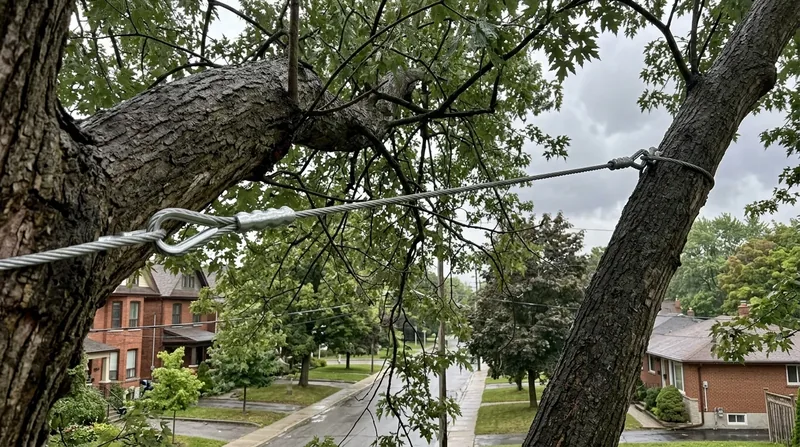




Tree cabling and bracing in Toronto is a structural support system that saves mature trees with weak crotches, splitting leaders, or codominant stems from removal. Our ISA Certified Arborists install cables and braces to redistribute load across the tree's crown, extending its life by decades. In Toronto, where mature maples and oaks line neighbourhood streets and frame backyard views, this technique is often the difference between preserving a 50-year-old landmark and grinding out its stump. We have been installing support systems since 2015, and we document every installation to help homeowners understand the long-term benefit. Call us at (437) 600-1089 for a free estimate, or visit our contact page to request a site assessment.
When a tree needs structural support in the Toronto area
Mature trees in Toronto backyards and street frontages often develop structural weaknesses that do not warrant removal. A sugar maple with a narrow crotch angle, a silver maple that has split after an ice storm, or an oak with a heavy limb growing at an unsafe angle can all be saved with the right support system. Rather than cut down a tree that still has decades of growth ahead, we assess the risk and install cables or braces to hold the weak points together. This approach is especially valuable when the tree provides shade, privacy, or wildlife habitat that would take years to replace.
- We inspect the tree's structure and measure crotch angles to identify failure points.
- We select cables or braces based on the species, crown size, and direction of stress.
- We install hardware at the correct height and angle to distribute load evenly.
- We monitor the installation over time and adjust tension as the tree grows.
This preventive work reduces the risk of branch failure during ice storms or high winds, which are common in in Toronto and the surrounding area's climate.
Local example: A 45-year-old red oak in Etobicoke with a severe split in its main crotch would cost $3,500 to $5,500 to remove and stump grind. Cabling and bracing the same tree costs $1,200 to $2,000 and keeps the tree alive and growing for another 30 years.
How we install cables and braces
Our installation process is methodical and respects the tree's biology. We do not drill large holes or girdle branches. We use dynamic cabling systems that allow the tree to move slightly in the wind, which actually strengthens the wood over time. Braces are used for younger trees or for very heavy limbs where cable alone cannot provide enough support. Every installation is designed to be invisible from the ground and to last 10 to 15 years or more, depending on the species and growth rate.
- We climb safely using rope and harness, never using spikes on healthy trees.
- We drill small holes through the sapwood and insert hardware that spreads the load across a wide area.
- We use cables rated for the species and crown weight, with turnbuckles for future adjustment.
- We trim any deadwood or crossing branches that might interfere with cable movement.
- We photograph and document the installation so you have a record for insurance or future work.
The entire process typically takes 2 to 4 hours for a single tree, depending on crown size and access. We clean up all debris and leave the site ready to use.
Real scenario: A birch tree in Long Branch with two codominant leaders competing for dominance. We installed three cables at different heights to balance the load, costing $1,600. Five years later, the tree is stronger and the homeowner avoided a $4,000 removal.
Cable and brace methods compared
| Method | Best for | Lifespan |
|---|---|---|
| Dynamic cable | Mature trees with weak crotches or split leaders; allows natural movement | 12 to 15 years |
| Rigid brace | Young or medium trees with heavy single limbs; restricts movement to heal the union | 8 to 12 years |
| Combination system | Large trees with multiple weak points; cables for main crotch, braces for secondary limbs | 10 to 15 years |
| Monitoring and adjustment | Any cabled or braced tree; turnbuckles allow tension adjustment as the tree grows | Ongoing, annual check recommended |
Regulations and site conditions in Toronto
Tree cabling and bracing does not require a permit from the City of Toronto, because the tree remains standing and no removal is taking place. However, if the tree is on a property with a heritage designation or is located in a ravine lot, the work may need approval from the city's heritage or ravine management office. We are familiar with these requirements and can advise you before work begins. If your tree is near hydro lines, we respect the approach distances required by your local utility or Hydro One and will not install cables that bring branches into contact with the distribution network. Our work is fully insured, and we provide a certificate of insurance upon request.
Most backyards in Toronto have tight access, often reachable only through a standard gate. We bring hand tools and climbing equipment, not heavy machinery, so we can work in confined spaces without damage to fences, gardens, or neighbouring property. For trees in ravine lots or on steep terrain, we use additional rigging to lower branches safely to ground level.
We recommend annual inspections of cabled trees, especially after heavy ice storms or summer windstorms. Cables can loosen over time as the tree grows, and turnbuckles may need adjustment. Our team can perform these check-ups and retension work at a fraction of the cost of a new installation.
Why choose our ISA Certified Arborists for cabling and bracing
Not every tree service company is qualified to install cables and braces correctly. Poor installation can actually harm the tree or create liability if a branch fails. Our team holds ISA Certified Arborist credentials, which means we have studied tree biology, biomechanics, and risk assessment. We understand the difference between a tree that needs support and one that should be removed. We also carry full liability insurance, so if something goes wrong, you are protected. Since 2015, we have installed support systems on hundreds of trees across Toronto and the surrounding municipalities, and we have never had a cable failure due to poor workmanship.
We also offer arborist reports and risk assessments if you want a detailed written opinion on the tree's structural condition before deciding on cabling. This report can also support an insurance claim or a municipal permit application if needed in the future.
For a free estimate and a site visit from one of our certified arborists, call (437) 600-1089 or visit our contact page. We respond within 24 hours and provide a detailed quote with photographs and installation timeline. If you have questions about whether your tree is a candidate for cabling, our team can assess it over the phone and advise you on the best option.
Prices Tree Cabling & Bracing in Toronto — Indicative pricing
| Service | Price | Details |
|---|---|---|
| Single tree, standard cabling | From $1,200 | Mature tree with one weak crotch, dynamic cable system, includes inspection and documentation |
| Multi-limb system (cables and braces) | From $2,000 | Large tree with multiple structural issues, combination of cables and braces, full assessment |
| Annual inspection and retention | From $400 | Existing cable or brace system, turnbuckle adjustment, safety check after ice or wind damage |
| Complex trees or difficult access | From $2,500 | Ravine lots, tight backyards, multiple trees, or trees near hydro lines—custom quote required |
| Travel and site visit | Included | Free estimate throughout Toronto and the surrounding area |
| Free estimate | No charge | Response within 24 hours, (437) 600-1089 |
Indicative prices; free, personalized estimate within 24h at (437) 600-1089.