



Tree planting in Toronto requires careful species selection, proper planting depth, and first-season care to establish healthy roots in our Southern in Toronto and the surrounding area climate. Our ISA Certified Arborists choose trees suited to areas 5 and 6, accounting for Toronto's variable winters, clay soils, and mature neighbourhood canopies. Whether you are restoring a ravine lot, filling a gap left by removal, or starting a new landscape, we handle site assessment, planting technique, and aftercare instruction to give your trees the best chance to thrive. We have served Toronto and the GTA since 2015, and we bring the same rigour to planting that we bring to removal and pruning.
Why tree planting matters in Toronto
Toronto's mature street trees and residential canopies are aging. Ice storms, windstorms, and disease (especially emerald ash borer) remove hundreds of trees each year. Replanting is not just aesthetic; it restores shade, reduces stormwater runoff on clay lots, and rebuilds the urban forest. Many homeowners plant trees themselves and lose them within two seasons because they choose the wrong species, plant too deep, or neglect early watering. A professional planting, combined with proper aftercare, cuts that failure rate dramatically.
- Select species proven to survive Toronto's freeze-thaw cycles and clay soil (sugar maple, red oak, white birch, Norway spruce, black locust).
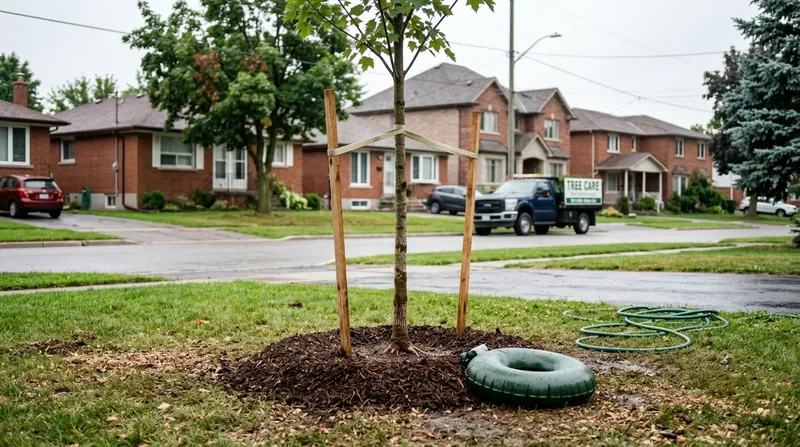
- Plant at the correct depth so the root collar sits level with grade, never buried.
- Stake young trees to prevent wind rock during their first growing season.
- Provide detailed watering and mulching instructions for the critical first year.
- Return for a follow-up inspection within 3 months to adjust ties and assess establishment.
Proper planting prevents costly failures and accelerates the transition from nursery stock to a mature canopy asset.
Key info: In Toronto, a newly planted 50 mm (2 inch) diameter tree costs between $195 and $350 depending on species, site access, and soil preparation. A larger specimen (75 to 100 mm) planted in a ravine lot or through a tight gate runs $400 to $650. All prices include staking, mulch ring, and first-season care instructions.
How we plant trees in the GTA
Our process begins with a site visit to assess soil condition, drainage, sun exposure, and space constraints. We then recommend species that will mature well in that microclimate: a sugar maple for deep shade in a Rosedale ravine lot, a red oak for an Etobicoke boulevard, a white birch for a Mississauga backyard. We source nursery stock from reputable growers and inspect it on arrival. Planting itself takes 45 minutes to 2 hours per tree, depending on site preparation and soil amendment needs.
- Dig a planting hole slightly wider than the root ball and at the same depth as the nursery container.
- Loosen compacted soil at the bottom and sides to encourage root penetration into surrounding clay.
- Position the tree so the root collar (where roots meet trunk) is exactly level with grade.
- Backfill with a mix of native soil and compost to improve drainage and nutrient availability.
- Install a 2-stake support system tied with flexible tree straps to allow some movement.
- Apply a 75 mm mulch ring (keeping mulch 100 mm away from the trunk) to retain moisture and moderate soil temperature.
- Water thoroughly and provide written care instructions: weekly watering during dry spells in year one, no fertilizer in the first season.
We return 8 to 12 weeks after planting to inspect the tree, adjust or remove stakes, and confirm that roots are establishing.
Local example: A homeowner in Long Branch lost two mature ash trees to emerald ash borer. We planted two red oaks (75 mm caliper) in their place, amended the clay soil with compost, staked them, and returned 10 weeks later to confirm good growth. Cost was $580 for both trees including staking, mulch, and aftercare. The trees are now 3 years established and over 4 metres tall.
Species selection and soil preparation
Southern in Toronto and the surrounding area's climate zone (5 to 6) limits which trees will thrive. Imported ornamentals often fail because they cannot tolerate our winter lows or summer heat. We focus on native and proven non-native species that handle freeze-thaw, clay soils, and variable moisture. Soil preparation is equally critical. Many Toronto lots have compacted fill, poor drainage, or high salt content from winter road treatment. We assess and amend before planting.
| Species | Characteristics | Best for |
|---|---|---|
| Sugar maple | Slow growth, excellent fall colour, deep roots, tolerates shade and clay. | Ravine lots, mature neighbourhoods, long-term canopy investment. |
| Red oak | Medium growth, large leaves, deeper roots than many oaks, handles compacted soil. | Boulevards, open yards, post-war subdivisions. |
| White birch | Fast growth, ornamental bark, prefers well-drained soil, moderate shade tolerance. | Backyard focal points, areas with good drainage. |
| Norway spruce | Evergreen, dense branching, hardy, tolerates wind and shade. | Windbreaks, hedge replacement, evergreen screens in ravines. |
We also offer black locust, serviceberry, and eastern white pine for specific microclimates. Visit our contact page to discuss species options for your lot.
Seasonal timing and aftercare
The best time to plant trees in Toronto is late fall (October through November) or early spring (March through April), when trees are dormant and soil moisture is stable. Planting in summer is possible but requires more frequent watering because heat stress is high. We avoid mid-winter planting when the ground is frozen. Once planted, trees need consistent moisture for the first growing season, roughly 25 to 40 litres per week during dry spells, delivered slowly to soak the root zone rather than run off. Mulch helps retain that moisture and keeps soil temperature moderate.
Many homeowners underestimate first-year care and lose newly planted trees to drought. We provide written instructions and are available by phone at (437) 600-1089 to answer questions throughout that critical first season. A follow-up inspection at 8 to 12 weeks confirms the tree is establishing well and allows us to adjust staking or mulch if needed.
Integration with removal and land clearing
Many planting projects follow tree removal or land clearing. If you are removing a hazardous ash tree, a diseased elm, or clearing a ravine lot for new construction, we coordinate the removal, site cleanup, and soil restoration before planting. This integrated approach ensures the new trees have clean, well-prepared ground and are not competing with old root systems or debris. We also offer wood chipping of removed material, which can be composted on-site to enrich planting beds.
For complex lots, steep ravines, poor drainage, heavy clay, or limited access, we assess the entire landscape and recommend whether planting, removal, or structural work should happen first. This planning prevents costly mistakes and maximizes the success of your new trees.
Professional planting versus DIY
A homeowner can plant a tree, but the details matter. Planting too deep (a common mistake) smothers the root collar and causes rot. Choosing a species unsuited to clay soil or winter cold leads to slow growth and early failure. Neglecting first-year watering kills young trees within months. Our ISA Certified Arborists have planted hundreds of trees in Toronto neighbourhoods and ravine lots. We know which species survive our winters, how to handle clay soil, and how to stake for long-term stability. The cost difference between DIY and professional planting is typically $150 to $300 per tree, a small premium that eliminates the risk of losing a $200 nursery tree and waiting another five years for canopy recovery.
Call us at (437) 600-1089 for a free estimate, or visit our pricing page for typical costs. We serve Toronto, Mississauga, Brampton, Vaughan, Markham, Richmond Hill, and all surrounding GTA communities.
Prices Tree Planting in Toronto — Indicative pricing
| Service | Price | Details |
|---|---|---|
| Small tree planting (50 mm calliper) | From $195 | Includes site assessment, planting, staking, mulch, and care instructions. |
| Medium tree planting (75 mm calliper) | From $350 | Larger specimen with enhanced soil preparation and support system. |
| Large or difficult-access planting (100+ mm or ravine lot) | From $500 | Complex soil work, equipment access, or specialized staking required. |
| Multiple trees or land restoration | From $1,200 | Bulk planting with coordinated soil amendment and phased establishment. |
| Follow-up inspection (8–12 weeks) | From $95 | Verify establishment, adjust stakes, confirm watering protocol. |
| Free estimate | No charge | Site visit, species recommendation, written quote within 24 hours. |
Indicative prices; free, personalized estimate within 24h at (437) 600-1089.